


TL;DR: Robots are most productive as a fleet, and the fleet needs an operating environment built to unlock fleet-level autonomy.
Imagine a robotic workforce that never clocks out: robots that never stop to charge, never stop to think, and coordinate perfectly across every task.
The early stages of this type of robotic workforce are already here. Amazon alone has deployed more than 1 million robots across its logistics network. Robots are taking on essential work in the AI economy: Watney Robotics raised an $80M Series A to build robots that handle cable swaps and server restarts in data centers, for instance. And the frontier is accelerating, with humanoid startups raising over $11B in 2026 alone, more than double last year’s record. With robotic foundation models advancing at a breakneck pace, the promise of a fully autonomous workforce that rivals or surpasses human productivity has never felt closer.
Despite all this progress, today’s robots are far from operating as a coordinated 24/7 workforce. Even the most capable ones stop every few hours to recharge, drain their batteries faster the more they think, and can’t see or coordinate with the robots around them.
Most of the industry is trying to fix this one robot at a time. We think the bigger unlock is the swarm. Like bees in a hive, a robot fleet’s value comes from how well individual units work together. True autonomy happens at that collective level, and this depends more on the environment around the fleet than on each individual unit.
The Montauk team has been deep-diving into the robotic autonomy space. Here’s what we found:
Robots are a fleet business: A fleet of people doesn’t get cheaper per unit as it grows, but a fleet of robots does, as long as the robots can work as a collective. Serve Robotics projects that robot deliveries will cost under $1 at fleet scale, versus $8 to $10 for a human courier.
Full autonomy has four parts: One lives inside the robot, and the other three live in the environment around a robotic fleet.
Reasoning: How much a robot can figure out on its own, from following routes set by fleet software all the way to taking plain-language instructions and handling situations it was never trained on. This is where most of the industry’s attention is going today, with companies like Physical Intelligence and Skild AI building the intelligence stack.
Power: How long a robot can keep working without stopping to charge. Robots can reason through complex tasks and still have to stop every few hours to charge, and very few have “charge autonomy” today.
Coordination: How well robots work with each other. Most vendors ship their own fleet software, so without an OEM-agnostic coordination layer, two robots from different vendors can work the same aisle and have no idea the other is there.
Orchestration: How well the site sees and manages the whole fleet. Nothing on site manages the fleet in one place today, so charging, tasks and compute can’t be planned across the full operation.
The opportunity: Foundation models make each robot smarter with every release, while power, coordination and orchestration get harder with every robot added to a site. A thousand robots competing for the same chargers, running heavy models off their own batteries and speaking different vendor languages is a systems problem no single robot can solve. This makes the robotic operating environment a durable picks-and-shovels opportunity, and one that remains under-innovated and under-invested.
Power
The physical AI “brains” of robots may be ready to run around the clock, but the “bodies” aren’t. If reasoning autonomy allows a robot to do whatever it needs to do to accomplish its tasks, charge autonomy decides how long it can keep doing them.
We define charge autonomy as how little a robot has to stop working, travel, wait, or rely on a person or spare hardware to stay powered. We rank it on six levels, from a human plugging the robot in (L0) to the robot topping up along its task path without ever stopping (L5):
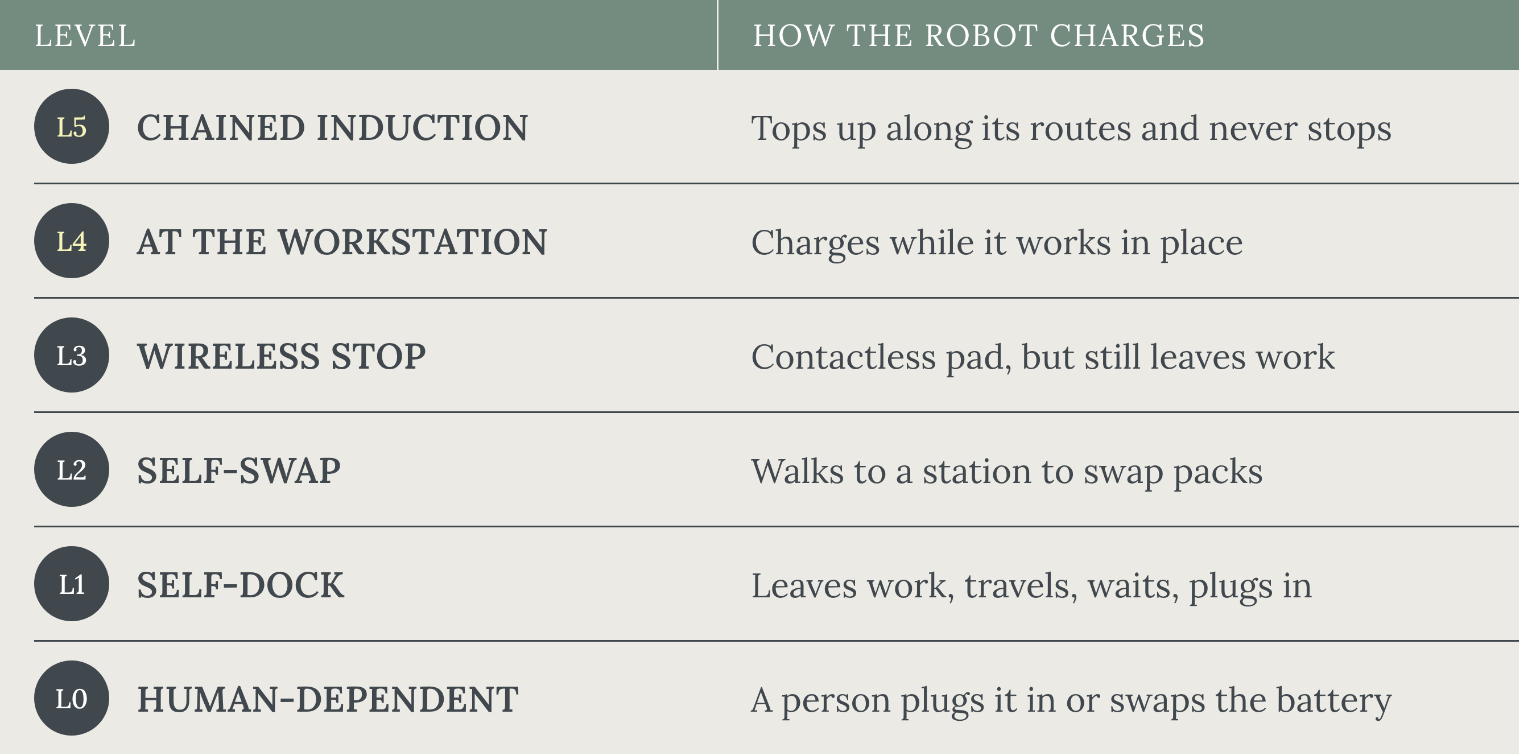
Most robots today sit low on the ladder, and the cost adds up quickly. Humanoids generally run just 1.5 to 5 hours on a charge, compared with 14 to 18 hours for wheeled robots. Faster charging doesn’t close the gap: Agility’s Digit recharges in about nine minutes but still has to walk back to its dock every 90. By our estimate, that travel, docking and waiting costs it ~4.3 hours a day, or ~156,000 productive hours a year across a 100-robot fleet. And when several robots run low at once, they end up waiting in line for a free charger, stretching each charge delay further as fleets grow.
Today’s charging options all fall short of full charge autonomy:
Human-dependent charging: Staff plug in or swap batteries on robots like the Pudu BellaBot, Unitree G1 and Apptronik’s Apollo, whose packs last about two to four hours. By our estimates, a 100-robot fleet of G1-class robots would need ~700 charging interventions a day and still lose ~415,000 productive hours a year, bringing back the labor the robots were meant to replace.
Robotic pit stops: UBTech’s Walker S2 swaps its own battery in about three minutes, and Atlas does the same. But the robot still leaves work, every unit needs spare packs, stations become a queue as fleets grow, and each OEM’s system is proprietary.
Wireless stops: Figure 03 charges at 2 kW by stepping onto a mat. That removes the plug, but the robot still has to make the trip to the mat.
With fleets scaling and the rise of robotics-as-a-service, every hour on a charger is lost revenue, and the overhead compounds: more docks, more queues, more spare packs and more load on site power.
Below, we map reasoning autonomy against charge autonomy. We rank reasoning autonomy on four tiers: Orchestrated robots follow routes and tasks set by fleet software (T1), Task Autonomy robots complete a defined task on their own and handle routine variation (T2), Learned Skills robots pick up new skills from data and demonstrations (T3), and Generalist robots take plain-language instructions and handle situations they were never trained on (T4).
Robotic systems that score highly in reasoning autonomy and charge autonomy live in the top-right corner, and today that corner is relatively empty:
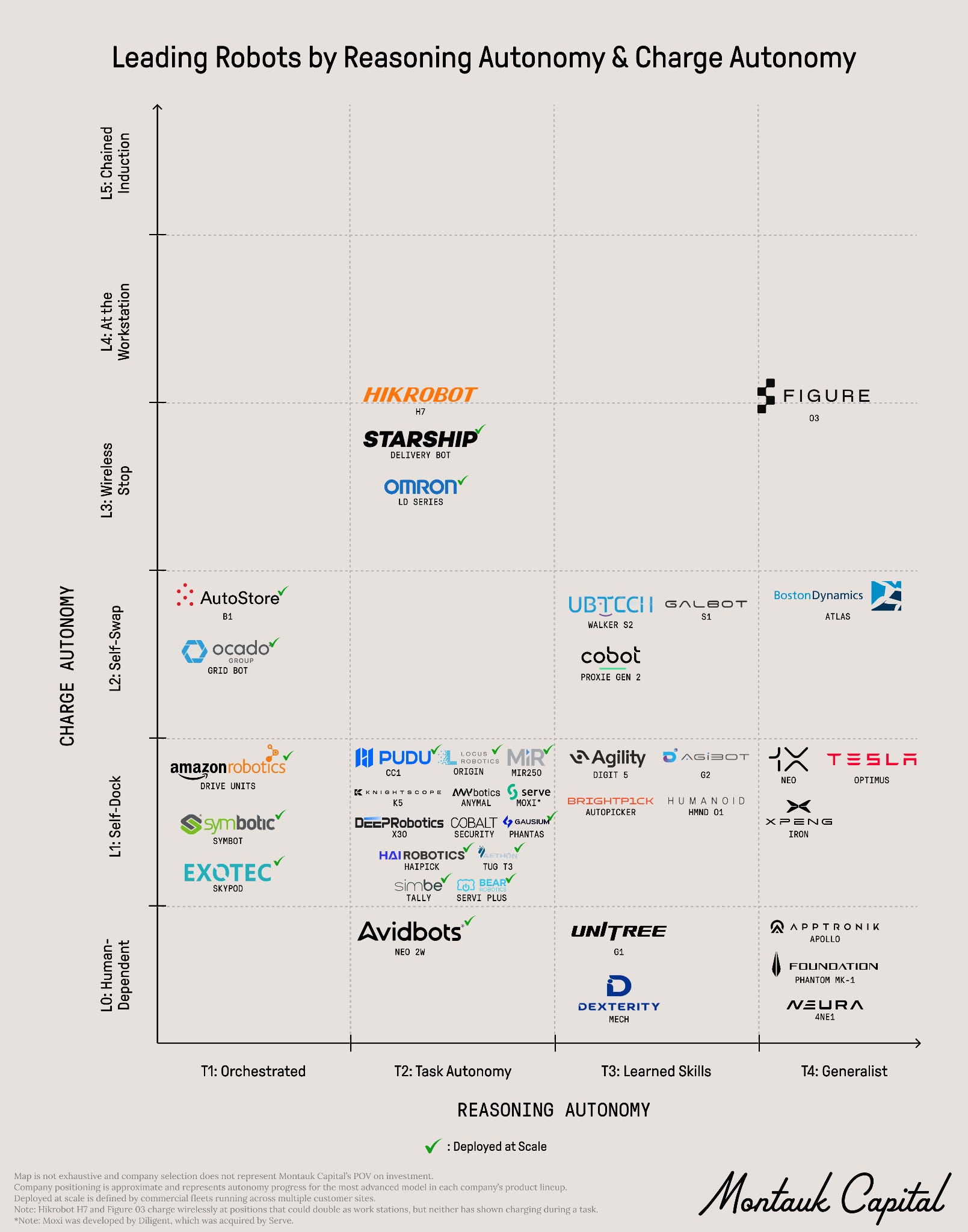
Mapping reasoning and charge autonomy alone tells a simple story: we’ve taught robots to think faster than we’ve built the environment to sustain them. Few robots on the market today, at scale, both think and run on their own. Add coordination and orchestration to the picture, and that gap only gets wider.
Coordination
Even a robot that never stops to charge still has to share the floor. Most sites already run more than one kind of robot, but vendors typically ship proprietary fleet software, so each brand sees only its own units. An AMR from one vendor and a humanoid from another can work the same aisle without knowing the other is there, leaving operators to juggle separate dashboards, maps and traffic rules. Interoperability standards are a start, but they still mostly cover basic commands and status updates.
The coordination gap gets more expensive with every robot added:
Blocked aisles: Robots that can’t see each other get in each other’s way.
Duplicate work: Without shared task lists, two robots can head for the same job.
Safety slowdowns: Robots that can’t anticipate each other’s moves treat one another as unknown obstacles, slowing down or stopping whenever another machine gets close.
Coordination, in turn, needs its own central “brain.” Centralized compute lets a fleet work as one system that reasons every robot at once, rather than each robot planning on its own. Fast reflexes for balance and collision avoidance can still stay on the robot, while planning and coordination can move to shared infrastructure.
The benefits of centralized compute:
Robots get cheaper: A robot that only needs to act, and not to plan, can carry smaller processing systems and batteries, which lowers the cost per unit.
Robots run longer: Compute that isn’t running on the robot doesn’t drain its battery, so more of each charge goes to actual work.
Coordination is centralized and awareness is shared: One brain assigns tasks and resolves conflicts across the whole fleet ahead of time, so every robot knows what the others know.
One central nervous system learns collectively: What one robot learns, the whole fleet learns. Updates ship once, and the fleet gets smarter with each infrastructure upgrade.
Orchestration
A fully autonomous workforce needs one orchestration layer that sees and manages the whole fleet: deciding which robot does what, when each one charges and where its models run. A well-orchestrated fleet staggers charging so robots never queue, routes work toward the units with the most charge, and keeps the most capable models running where they matter most, turning a set of individual machines into a workforce whose output exceeds the sum of its robots.
Today, almost all robot compute sits on-device. Figure’s Helix runs entirely on embedded GPUs, and Agility and Boston Dynamics are adopting NVIDIA’s Jetson Thor as the onboard compute for Digit and Atlas, which means running models off the same battery that powers the robot.
That forces a trade-off between thinking and working:
More compute drains the battery: Jetson Thor draws 40 to 130W. At full load over a five-hour shift, that comes to ~0.65 kWh by our estimate, roughly a quarter of Figure 03’s battery spent on thinking rather than working.
Less compute weakens reasoning: In a Microsoft Research lab study, the same manipulation policy succeeded 80% of the time on a Jetson Thor but only 30% on a smaller Jetson Orin, because the smaller chip took three times as long to decide each move.
At the fleet level, the compute problem gets bigger. Coordinating every robot on site in real time is far more compute-intensive than running any one robot, and that overhead compounds as fleets grow. Shared compute at the site, close to the robots and independent of any one vendor’s cloud, gives the fleet the bandwidth it needs and lets robots run more capable models without cutting into their runtime.
The Autonomy Knot
Reasoning, power, coordination and orchestration are usually treated as separate problems. Full autonomy depends on all four holding together, like strands in a single knot:
Power caps reasoning: A robot running its models off its own battery has to ration energy between thinking and working. A robot that never stops to charge can run the more capable models that make it smarter in the first place.
Reasoning stretches power: A robot that understands its task, its surroundings and its own state of charge can top up during natural pauses and cut wasted motion, stretching every kilowatt-hour further.
Coordination multiplies everything else: A fleet that can share tasks, paths and chargers gets more out of every robot’s reasoning and every kilowatt-hour.
Orchestration pulls the knot tight: It turns each robot’s reasoning and power into coordinated output across the whole fleet.
Pull on one strand alone and the others become key constraints. Solve them together in the operating environment, and full autonomy for the fleet comes within reach.
Rethinking the Operating Environment
Reasoning models have carried robots far, but the rest of the path toward a true 24/7 workforce with full coordination runs through the environment robots work within.
We believe the winner here will be OEM-agnostic, compute-enabled and energy-aware: one system that powers, coordinates and orchestrates every robot on site, regardless of brand.
This type of system will serve as the robot economy’s critical infrastructure layer that becomes more valuable with every robot it serves, paying for itself in its ability to uplevel robot output. By our estimates, this type of system could recover hundreds of thousands of productive hours a year vs. today’s operations for fleets at scale (100+ robots). We foresee ROI will show up first in high-utilization, mixed fleets running multi-shift operations in warehouses, factories and data centers, where every recovered hour flows straight to revenue, with new frontiers emerging as robotic adoption continues to accelerate.
The next wave of robotics will be measured by what fleets get done together. At Montauk, we’ve been investigating solutions in this space. If you’re an investor, partner, robotics operator or founder interested in combining forces, please feel free to reach out. And if you want to help build it, we’re hiring.
Agree on all points, my research is in fact on multi robot communication and continual learning without need of external compute.