

For most of the space age, electricity has been a constraint that missions were designed around.
In fact, power in space is still measured in kilowatts instead of megawatts because solar is the only real option for power generation today, but arrays will soon tap out on size. That ceiling now has national stakes as the U.S. and China race to build permanent bases on the moon. Whoever powers those bases first will set the rules for operation. Nuclear is the clearest path to megawatt-scale power in space, but getting there will take real innovation in integrating the reactor, power conversion, and heat rejection into a single system.
Space power is now a national priority: The U.S. is racing China and Russia to put a reactor on the moon, and this year’s federal actions, from NSTM-3 to the joint DOE and NASA push, have made space nuclear a strategic priority.
More power unlocks the space economy: Recent projections put the lunar economy alone at up to $550B by 2050, and lunar mining, in-space manufacturing, continuous space-based radar, orbital compute, and faster trips to Mars will all need far more power than solar can deliver.
The reactor is only half of the problem: In a vacuum, waste heat can only be radiated away, so the reactor, power conversion, and radiator have to be designed together.
High-power systems are still scarce: Billions are flowing into terrestrial nuclear and space power and propulsion, but few companies are building integrated, high-power space nuclear systems.
AI is compressing the timeline: Physics-based AI models cut nuclear calculations that used to take months down to minutes, which will enable a reactor to be launched faster than ever before.
The New York Times recently ran a front-page piece covering the race to put nuclear reactors on the moon. In late August, NASA asked contractors to prepare to build a 20 kW reactor that can launch by December 2030, while Russia is developing a 10 kW reactor to power China’s lunar stations by 2036. NASA has already sped up its timeline, in part because it’s worried a Russian-Chinese reactor could set up a de facto lunar exclusion zone.
Two details from the NYT’s reporting stood out to us. First, the U.S. flew just one fission reactor in space, back in 1965, while the Soviet Union has flown more than 30. Since then, the U.S. has spent more than $20B on space nuclear programs without launching another. Second, the first challenge raised for space reactors is “how to get rid of heat,” which is exactly the problem we’ve been focused on.
Policy and funding are also moving quickly to match geopolitical urgency. NSTM-3 launched a national initiative for American space nuclear power in April, NASA’s SR-1 Freedom is targeting a nuclear-powered launch to Mars in December 2028, and last month the Pentagon selected Antares for a $161M space reactor demonstration. We expect more solicitations to follow.
Space Power Needs Are Scaling from Kilowatts to Megawatts
Emerging applications like in-space manufacturing, defense applications, orbital compute, lunar mining, and faster trips to Mars are changing the scale of power requirements. For example, Cowboy Space expanded from space-based solar to designing orbital compute platforms where each upper stage becomes a 1 MW data center. At that scale, power stops looking like a spacecraft subsystem and starts looking like heavy infrastructure. We see that demand concentrating in two key places, each with unique requirements:
Orbit: Compute, manufacturing, and high-power electric propulsion point to systems in the hundreds of kilowatts up to around a megawatt, where launch mass, radiator size, and flight approval set the limits.
Lunar surface: A moon base needs tens of kilowatts to ~100 kW from a system that can survive two-week nights, temperature swings of more than 450°F, and a landing on uneven terrain.
Most funded designs today sit at the low end of these ranges, and we think there’s room for innovation across both arenas.
Solar Works Today, but Power-Hungry Missions Need More
Solar will continue to power much of what we do in space, and nuclear will work alongside it to take on missions that demand continuous, high power. As power needs climb, arrays will get bigger and heavier, and they still go dark during eclipses, lunar nights, and deep space missions far from the Sun. Even in low Earth orbit, many satellites spend up to a third of every orbit in Earth’s shadow. Government operations, like high-power space-based radar, already push solar’s limits.
We’re also seeing increased demand for power as a service in orbit. Star Catcher raised a $65M Series A this spring to beam power to satellites, and Mantis Space, a Montauk portfolio company, launched from stealth earlier this year with a $10M seed round to build orbital power delivery so operators don’t lose capacity during eclipses. As these networks grow, they’ll need denser, always-on sources to draw from, and that’s where nuclear fits in. We see a future where a space reactor acts as the power plant and companies like Mantis act as the transmission lines, delivering that power wherever it’s needed in orbit or on the lunar surface.
The Reactor Is Only Half of the Problem
In space, the radiator is a key design constraint. Most of the heat a reactor produces can’t be turned into electricity, and in a vacuum the only way to get rid of it is to radiate it away. Because the heat a radiator sheds rises with the fourth power of its temperature, a radiator that runs twice as hot (in Kelvin), needs ~1/16 of the area to reject the same heat. Since running hotter also affects conversion efficiency, materials, fuel performance, and component life, the reactor and its thermal system have to be designed together.
NASA’s earlier 100 kW lunar reference design, for example, needs ~350-380 square meters of radiator, which is more area than a comparable solar array. We don’t see this as an argument against nuclear, but rather an illustration of what happens when a space reactor is built around a relatively low-temperature design, and why we think the thermal system is one of the key places to innovate.
What It Takes to Win
Building on our research and conversations across the space and nuclear industries, we’ve built conviction that the winning space nuclear company will have a combination of the following:
1. A design built around heat rejection: Rather than designing a reactor first and sizing the radiator around it, the winner will start from heat rejection and push toward higher operating temperatures, with the fuel, materials, and power conversion to handle them. That’s where the biggest gains in mass and power are.
2. Full system ownership: Because the radiator sets the requirements for the rest of the reactor, we don’t think a standalone component supplier wins here. The value sits with whoever integrates the full power system, owns the safety case, secures launch approval, and builds up flight heritage.
3. Speed in design iteration: Reactor design has historically been slow because the physics is expensive to simulate, and every design change has to be coordinated across multidisciplinary teams. This is where we think a new entrant can pull ahead (more on this below).
Market Map: Who’s Building Space Power and Propulsion
Capital and talent are pouring into nuclear, space power, and in-space propulsion, and the three are only starting to come together. We mapped who’s building what, where companies can partner to build out the space economy, and where terrestrial approaches will hit their limits in space.
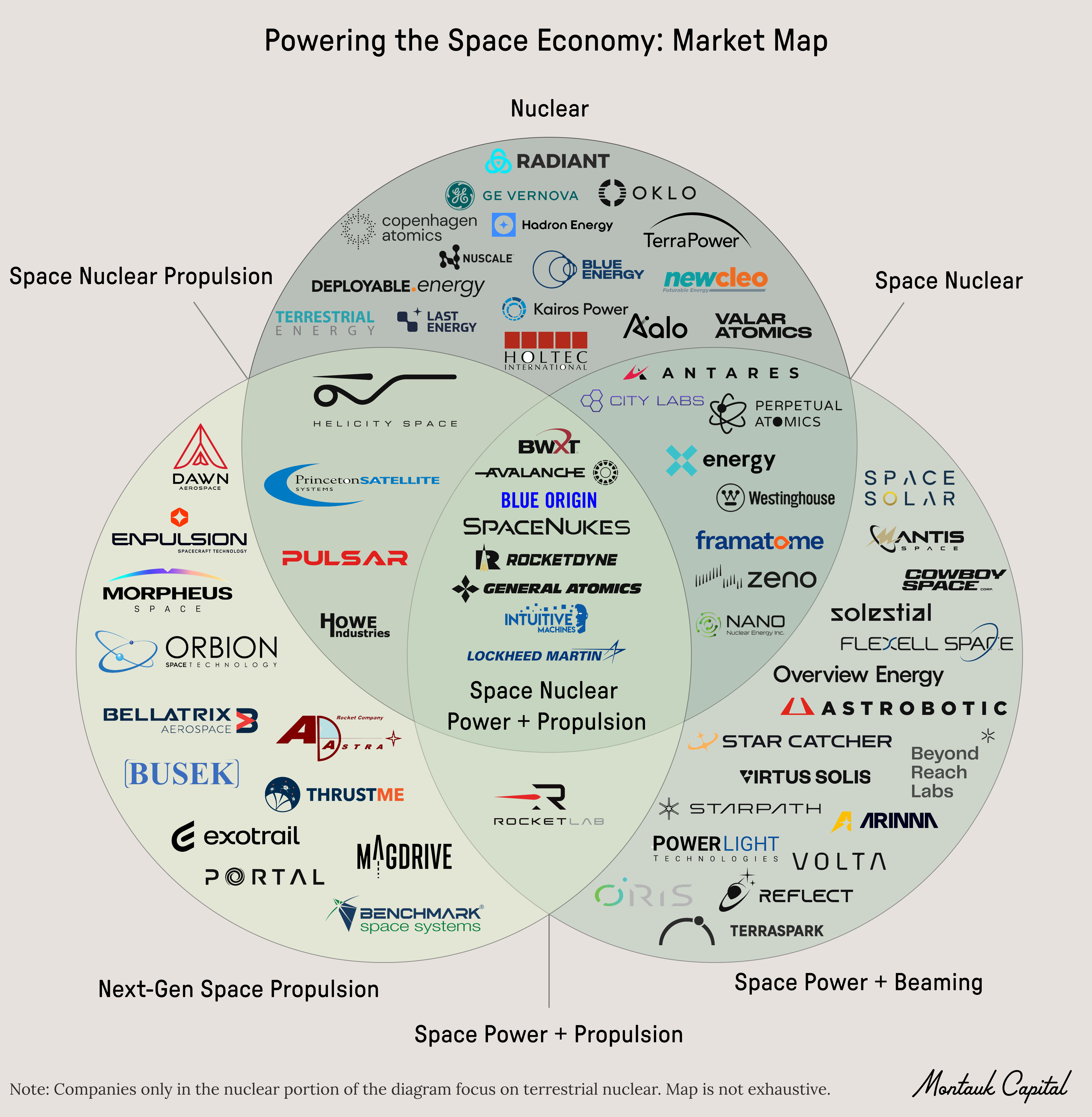
Space nuclear: Since NASA’s August 2025 push to fast track a lunar reactor, terrestrial reactor companies have started lining up. The players now span the full range of nuclear: microreactor startups like Antares and NANO Nuclear, established reactor makers Westinghouse and X-energy, which have adapted their designs for lunar reactor studies, and aerospace incumbents Lockheed Martin and Rocketdyne, which is building NASA’s radioisotope generator. Space-first companies fall into two camps: radioisotope companies like Zeno Power and Perpetual Atomics turn natural radioactive decay into anywhere from a few watts to a few hundred watts for decades, while fission developers like Space Nuclear Power Corp can scale from kilowatts toward megawatts for larger platforms and lunar bases.
Space nuclear propulsion: This segment of the market is still largely government-led, with players falling into three camps. Within nuclear thermal propulsion, a reactor heats propellant directly for high thrust and faster trips to Mars, with incumbents like BWXT and General Atomics leading on reactor design and fuel. In nuclear electric propulsion, a reactor generates electricity to run highly efficient thrusters, which is why companies like Space Nuclear Power Corp, already developing reactors for space power, are also designing systems for propulsion. Avalanche Energy, Helicity Space, Pulsar Fusion, and Princeton Satellite Systems are taking different approaches to fusion propulsion, from compact micro-fusion devices to direct fusion drives. Across all three categories, the unlock is a single nuclear system that can both power a spacecraft and move it, and nuclear electric propulsion is the most mature path to that today.
Space power and beaming: Most activity here focuses on either moving power down to Earth or across space. Space-based solar power companies like Space Solar, Virtus Solis, and Overview Energy collect sunlight in orbit and send it down to the grid on Earth, while Reflect Orbital uses orbital mirrors to redirect sunlight to solar farms. In-space power beaming companies like Star Catcher, Mantis Space, and Volta Space deliver power to other spacecraft or the lunar surface, so assets can keep running through eclipse or lunar nights. However, most of these companies still draw their energy from the sun, so they’ll inherit solar’s scaling limits as power demand grows, making space nuclear a natural complement.
Next-gen space propulsion: These companies are building the engines that move spacecraft once they’re in orbit, without relying on nuclear today. Electric propulsion players like Exotrail, Enpulsion, and Magdrive use electricity to accelerate propellant very efficiently, Portal Space Systems uses concentrated sunlight to heat propellant for fast maneuvers, and companies like Dawn Aerospace are making cleaner chemical thrusters. That being said, electric thrusters are ultimately limited by the power available onboard, which is where a reactor comes in.
Terrestrial nuclear: >$6B has gone into fission and fusion startups so far in 2026, including billion-dollar rounds for Commonwealth Fusion Systems and Valar Atomics. Although this momentum is great for the nuclear industry as a whole, many terrestrial advanced reactor designs don’t translate to space. Water-cooled reactors, including most SMRs, run too cool and need heavy pressure vessels, which would mean enormous radiators and launch mass, while molten salt and many passively cooled designs rely on gravity to move fuel or shut down safely. Regardless, space nuclear will benefit from the talent and supply chain each company is building.
There’s momentum across every part of the map, but the center is still mostly incumbents and government programs, and much of that work is either low power, limited to a single component, or still at the study stage. Very few companies are designing the reactor, power conversion, and thermal system together at high power with a clear path to flight, and that’s where we see the most opportunity.
What's Driving Faster Tech Development
Traditional reactor design can take a decade. Large, siloed engineering teams iterate slowly, and designs often still aren’t finished once construction starts, which leads to delays and cost overruns.
We believe that using nuclear physics-based AI models is one way to cut calculations that used to take months down to minutes, which lets us explore and optimize far more designs than a traditional program could. Leading teams will be differentiated by using that speed to work backward from an ideal high-temperature space reactor to the handful of research bets in fuel, core geometry, and heat transfer that could create a step change in performance, leaving more time and funding for manufacturing.
Proprietary AI-powered digital engineering tools are now able to connect design, quality assurance, and manufacturing into a single digital thread, so a lean team of experts can move faster than a traditional organization. Early concepts are promising and we’re excited to meet folks working in, or looking to invest, in this sector.
Power Is the Next Frontier
Over the last decade, launch costs have fallen dramatically. We believe power is the next constraint to solve in space, and solar alone won’t get us there.
If you’re an investor, partner, nuclear or space enthusiast, or a founder working on any piece of this, we’d love to hear from you.
The connection between orbital compute and space power is becoming hard to ignore. Reliable megawatt-scale computing will depend not only on generating electricity, but also on managing waste heat in a vacuum. The companies that treat power, thermal control, and mission design as connected challenges could help shape what becomes practical in orbit.